
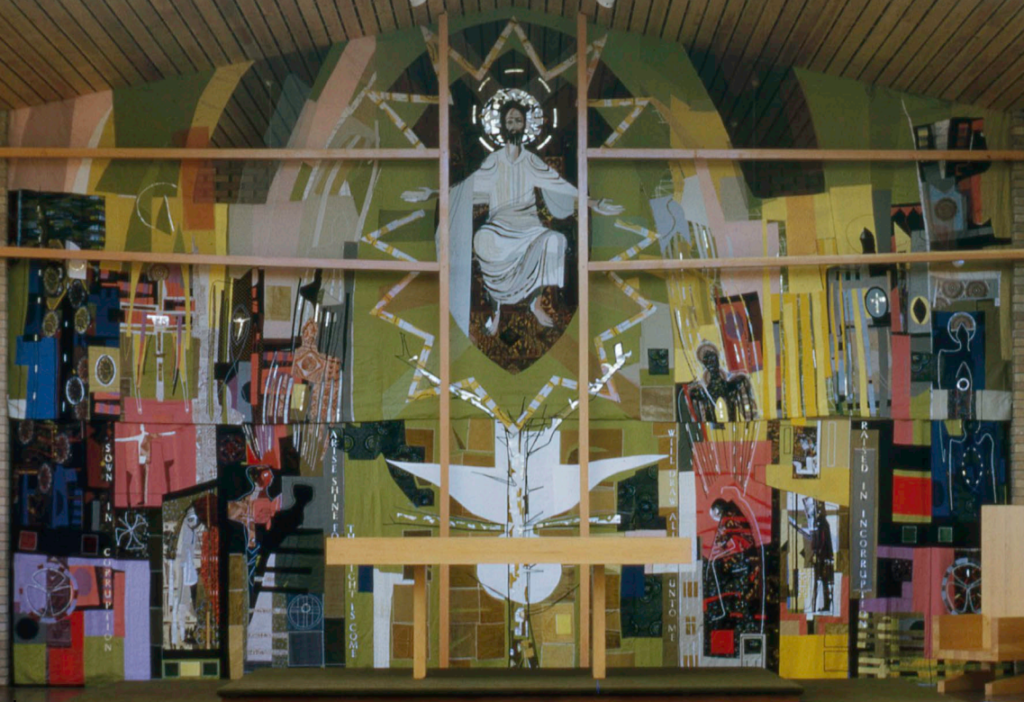
The applique was completed in 1964, with production beginning in 1963, and the design process in 1962, by David Holt, with the wooden Cross made and positioned by Gerald Holtom. The applique is at the heart of the Chapel, at the geographical centre of the university, commissioned by the then principle Rev. F Mason and the board of governors, who took more time to design it and the Chapel than anything else on campus. It displays Christ in Majesty, from which the Chapel derives its name, (The Chapel of Christ in Majesty) and reveals a theological message about the core of the university.
Canterbury Christ Church University has a Church of England foundation. It is built on the UNESCO world heritage site of Saint Augustine’s Abbey, the original site of the Canterbury School of Hadrian and Theodore with the land still held in covenant by the Church of England, and has the Archbishop of Canterbury as its chancellor. The university therefore has been shaped by a Christian way of life: a rhythm of daily prayer, and Christian values which inform all aspects of institutional life. At the heart of the University sits Christ, an invitation to look directly to Him, and seek to imitate Him, living in His light, His hope, and crucially His love which is available for all.
Canterbury Christ Church University remains a lead Cathedrals group university and a central member of CUAC.
The design process, symbolism, and meaning
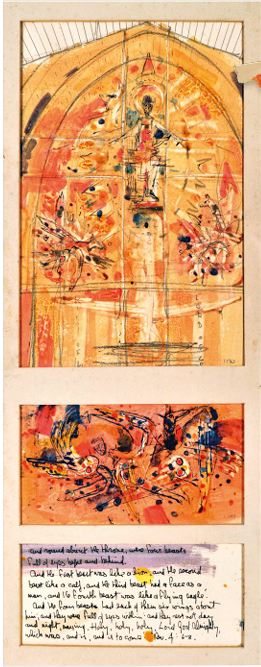
To the left reads:
‘and round about the throne, were four beasts Full of eyes before and behind. and the first beast was like a lion, and the second beast like a calf, and the third beast has a face as a man, and the fourth beast was like a flying eagle and the four beasts had each of them six wings about Him; and they were full of within and they rest not day and night, saying, Holy, holy, holy, Lord God almighty, which was, and is, and is to come. Rev. 4: 6-8’

The boxes to the right contain quotes from:
‘1 Corinthians 5:38, Isaiah 60:1, John 12:32 and 1 Corinthians 15:20’
Beneath these reads: ‘plant,’ ‘man,’ ‘beast,’ ‘man.’ In the centre: ‘I am the resurrection, the life. Tree, chalice.’ Followed again by ‘man,’ ‘beast,’ ‘man,’ ‘plant.’
The bottom of the page reads:
‘seed of man. adam.’ ‘tree of man.’
Above are two of David Holt’s earlier sketches.
The sketch on the left is based entirely on the passage below it from Revelations, depicting the beasts in worship of the Risen Christ. Above, we can see Holt moving towards something more similar to the final design, which incorporates other passages of scripture and the style of the sketch at the very top of the page.
The passages of scripture, boxy layout and the centrality of the Cross and Risen Christ all are incorporated into the final design.
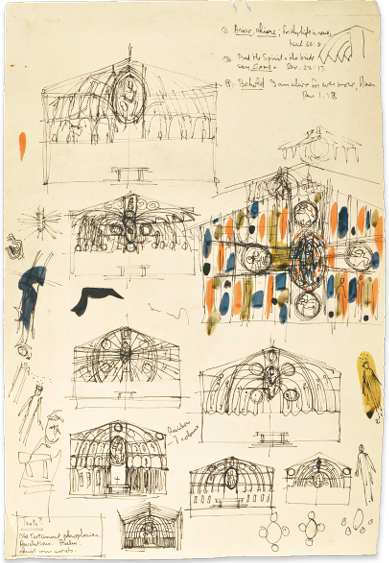
The text in this page reads:
‘① Arise, shine; for thy light is come, Isaiah 60:2
② And the Spirit & the bride say Come. Rev. 22:17
③ Behold I am alive for evermore, Amen Rev 1.18′
Beneath this reads:
‘Texts?
Old Testament prophesies. Revelations. Psalms. Christ’s own words.‘

Above are more conceptual sketches that centre a large cross spanning the Chapel’s width and height, with Christ in majesty within this. In his notes, Holt is moving away from the abstract worship of Revelation above, towards a theme of redemption, rebirth and presence, in a personal, communicable sense.
In both of these sketches, his final design is taking place, which he tries to imagine within the setting of the Chapel.

The boxes above are quotes from scripture, cited beneath them reading:
‘‘1 Cor 5:42, Ro 8:22, Isa 60:1’ ‘I am the Resurrection & the Life. (chalice. Tree:Stem of Jesse)’ ‘John 12: 32, Romans 8:21, 1 Cor 15:20’
This is the sketch most similar to the finished project hanging in Chapel. The majority of the quotes here are sewn into the applique, and this is the only sketch where Holt clearly divides it into two thematic halves. The top, with the exalted Christ is labeled ‘Light,’ and this light, even in simple black ink can clearly be seen to emanate from Christ, reaching downwards into the darkness. He, as with all earlier sketches has Christ in majesty, the Cross, and the reflected tree and chalice central.
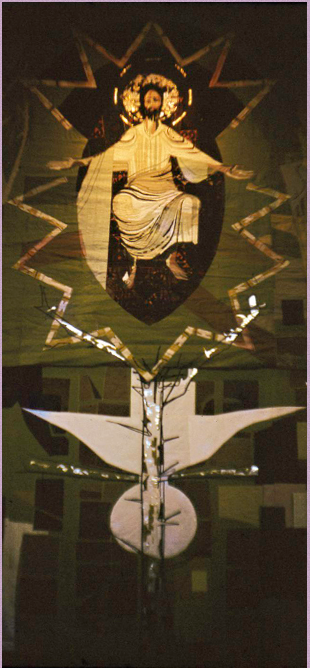
This is a picture taken of the central part of the finished applique depicting Christ in Majesty-Jesus resurrected and in heaven. Beneath Him (the white shape) is His reflected image, which takes the shape of a chalice.
This is designed to evoke memory of the Eucharist, an acknowledgement of the Church of England foundation of our University and Chapel, and the belief in the bread and wine being the body and blood of Jesus broken and spilled for us.
It is important to have the reminder of the mirror image of Christ. He is exalted and raised to new life because He died in love upon the Cross, that we all may share in His new life, and His new creation. The loss and the triumph cannot exist without the other, and so the chalice serves as a reminder of the last supper and the sacrifice of Christ, the necessary precedent of the resurrection.
Even the ascended Christ acknowledges the past reality of His death, with the strip of white cloth hanging from His left arm a burial shroud, a reminder of death defeated and taken up into heaven.
Beneath Christ also is a tree. Holt in his notes emphases this as the stem of Jesse, from Isaiah 11:1 which reads: ‘A shoot shall come out from the stump of Jesse, and a branch shall grow out of its roots.’ Jesse was the father of King David, the man who it was prophesied the Messiah (the one who would liberate Jewish Israel) would descend from. The Bible tells us Jesus descends from David, but He liberates the whole world, not just Israel.
This metaphor of the tree points towards hope, new life and revival. In Jesus, though only a seemingly dead stump survives, there is always hope.
It could also depict at the same time the Tree of Life, mentioned in Genesis 2:9, but also Revelation 22:2. Some texts not in the Bible contain legends of Christ’s Cross being made from the Tree of Life.
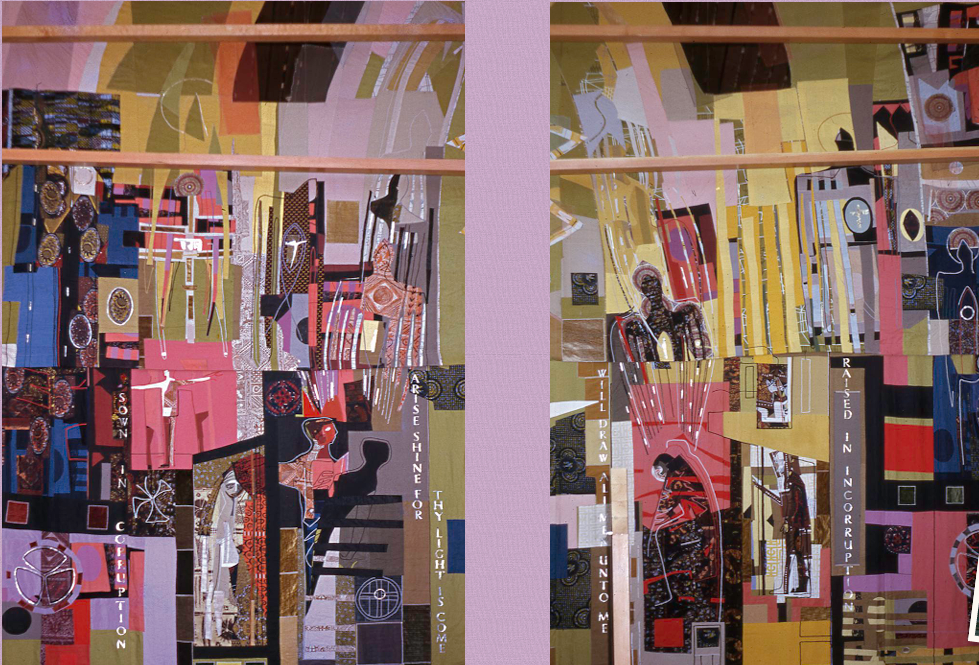
Finally, here are two panels of the applique, focused on the bottom half, which as Holt’s notes detail, is made up of darker colours, and boxes as in the early sketch.
These boxes contain within them people who appear to be sad or suffering, the woman in grey at the bottom centre left a clear example of both the emotion and boxes.
However, we see also that the yellow light from the top half, where Christ resides, is reaching downwards in beams, opening these boxes-which are in fact tombs, and setting free those inside.
Christ’s light liberates, and even in the darkness, He is there. The pieces of the applique which remain darkly coloured are filled with Crosses, (see how many you can count!) a reminder that His love is always with us, even in our struggle or ignorance.
A fun challenge! A cat is hidden within the applique, message the Chaplaincy team on Instagram @chaplaincycccu if you think you’ve found it.
David Holt was a world renowned artist, colleague, and friend of the Chapel